
Quick answer
There is no wrong choice between a pet urn and scattering ashes. An urn keeps your pet close and can move with you; scattering returns them to a meaningful place but cannot be undone. Many families do both, keeping a portion in an urn or keepsake and scattering the rest after checking local rules.
When the ashes come home, many families face a quiet question: should we keep them in a pet urn or scatter the ashes somewhere special? Both choices are loving, and neither has to be made straight away.
This guide sets out the advantages and drawbacks of each option, explains how splitting ashes works, and lists the permissions worth checking before you scatter. It also offers a few questions to talk through as a family, so the decision you reach feels settled and right for everyone.
There Is No Need to Decide Straight Away
Ashes are usually returned in a sealed bag inside a simple temporary container, and they can stay there safely for as long as you need. Some families decide within days; others wait months or longer until the right moment or place becomes clear.
Grief can make every decision feel urgent, but this one rarely is. Waiting gives everyone in the household time to share their feelings, and it means you can plan a ceremony rather than rush one. It can also help to notice how each person feels when they imagine the options. Sometimes one choice brings a sense of relief, and that feeling is worth paying attention to. If you are finding the days after your loss hard, our guide on coping with pet loss may help.
Pet Urn or Scattering Ashes: Pros and Cons
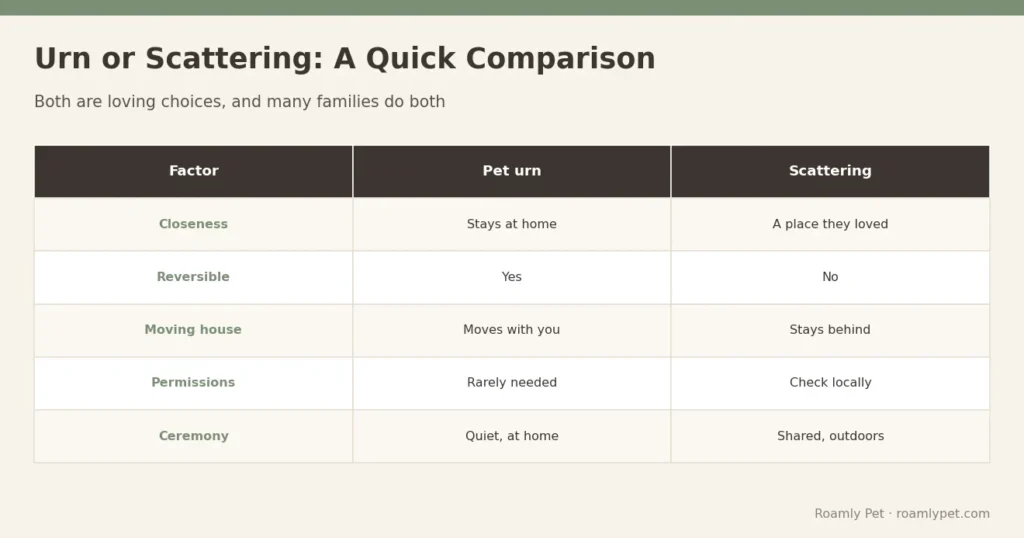
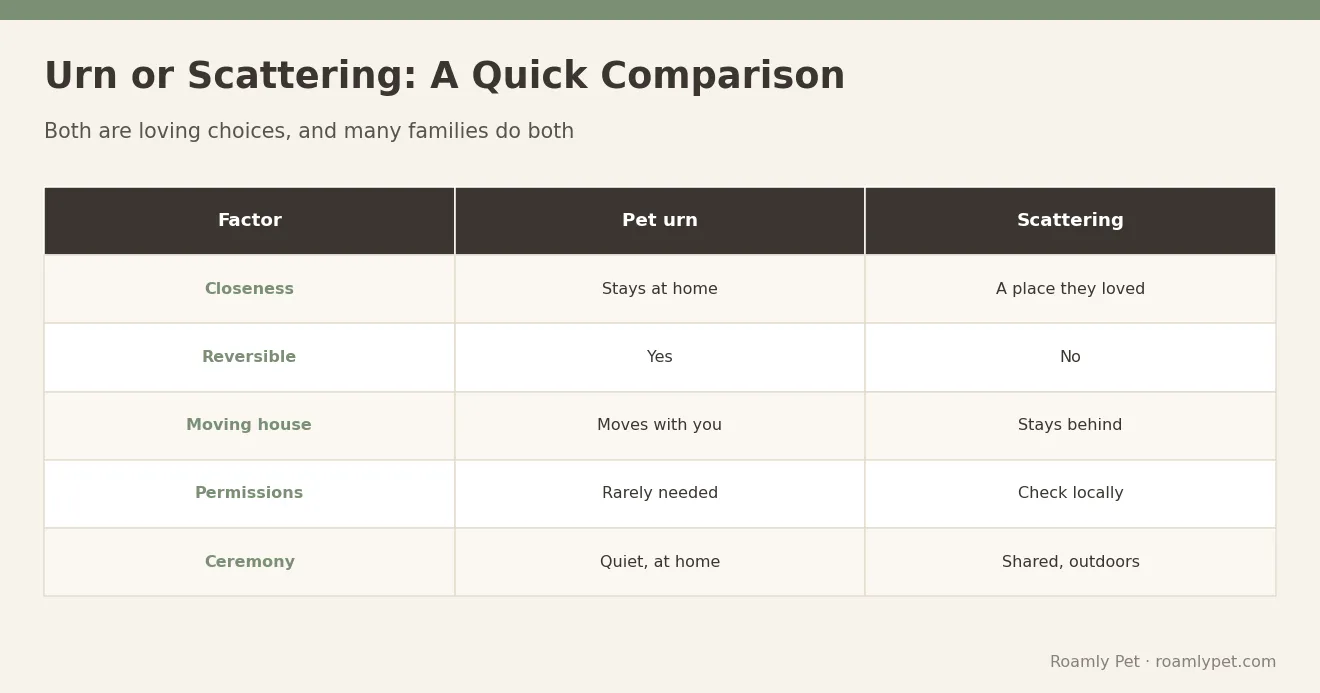
Here is a side-by-side look at the two main options:
| Consideration | Keeping a pet urn | Scattering ashes |
|---|---|---|
| Closeness | Your pet stays at home with you | Your pet rests in a place they loved |
| Reversibility | You can still scatter later | Cannot be undone |
| Moving house | The urn moves with you | The place stays behind |
| Ceremony | A quiet placing at home | A shared moment outdoors |
| Permissions | Rarely an issue at home | Depends on the location |
Neither column is better. The right choice depends on what brings your family comfort, both now and in the years ahead.
Why Families Choose to Keep an Urn
Keeping ashes in an urn appeals to people who want their pet to remain part of daily life. Reasons families often mention:
- Having a focal point at home for remembering, perhaps with a photo and collar nearby.
- Being able to take the urn along if they move.
- Leaving the option open to scatter, bury or combine ashes with a future companion.
- Personalization, such as an engraved name or a photo, which makes the urn a memorial in its own right.
An urn also suits families who are not yet sure. Keeping the ashes for now does not close off any other choice later. Wood and ceramic urns can be displayed openly or kept in a quiet cupboard, whichever feels more comfortable to live with day to day.
Why Families Choose to Scatter
Scattering can feel like setting your pet free in a place they loved: a favourite beach, a woodland walk, the field behind the house. For some, it is a natural ending that brings a sense of peace.
Scattering often suits families who:
- Prefer not to keep ashes in the home.
- Associate their pet strongly with one outdoor place.
- Want a shared ceremony with friends or relatives.
The main thing to remember is that scattering is permanent. If anyone in the family feels unsure, consider keeping a small portion before you scatter the rest.
On the day itself, check the weather and wind direction, stand with the wind at your back, and pour the ashes low to the ground or water. Some families scatter flower petals afterwards or say a few words. Bringing a photo of your pet can make the moment feel more personal.
Splitting Ashes: The Best of Both
Many families find they do not need to choose. Splitting ashes lets you keep some and scatter or bury the rest. Common arrangements include:
- A main urn at home plus a scattering at a favourite place.
- Small keepsakes for each family member, with the rest scattered.
- A portion buried in a biodegradable urn in the garden, with a keepsake indoors.
To divide ashes, work over a tray or a sheet of paper on a calm, still day, and use a small spoon or funnel. Our guide to keepsake pet urns for sharing ashes explains this gently and in more detail. If burial appeals, see our guide to biodegradable pet urns.
Permissions to Check Before Scattering
Rules about scattering ashes vary widely between countries, regions and landowners, so it is worth checking before you go. In general:
- Your own land: usually the simplest option, though local rules can still apply.
- Someone else’s land: ask the owner first.
- Parks, beaches and nature reserves: contact the managing authority, which may have guidance or a permit process.
- Rivers, lakes and the sea: environmental agencies sometimes have guidance about locations.
- Abroad: airlines and border authorities have their own rules on carrying ashes.
If you are planning to travel, our guide to traveling with pet ashes covers what to check with your airline and TSA or the local equivalent.
Questions to Talk Through as a Family
If you are unsure, talking these questions through together can help:
- Is there a place that feels like it belonged to our pet?
- Would we like somewhere to visit, or somewhere to keep them close?
- Are we likely to move home in the next few years?
- Does everyone, including children, feel comfortable with the plan?
- Would anyone like to keep a small portion for themselves?
Listening to each other matters more than reaching an answer quickly. Often the right choice becomes obvious once everyone has spoken. If opinions still differ, splitting the ashes lets each person honour your pet in the way that feels right to them.
Finding a Fitting Urn
If you decide to keep some or all of the ashes, Roamly Pet offers solid wood and hand-glazed ceramic urns, as well as biodegradable salt urns for burial or water. Most styles can be personalized with free name-and-date engraving, optional photo laser-engraving or a cast paw print, depending on the product. Each urn is made or engraved to order and shipped within 3 to 5 business days.
You can browse all our pet urns at your own pace. If you are splitting ashes and would like help choosing sizes, or have a question about engraving, please contact us. We are glad to help.
Frequently Asked Questions
How long can I keep ashes before deciding what to do?
As long as you need. The ashes are stable and can stay safely in their temporary container for months or even years. Many families wait for a meaningful date, a family gathering or simply the moment it feels right. There is no deadline, and taking time is completely normal.
Is it bad to keep pet ashes at home?
Not at all. Keeping ashes at home is one of the most common choices, and many people find it comforting to have their pet nearby. An urn can sit on a shelf, with a photo or collar beside it, and it can move with you if you change homes.
Can I scatter some ashes and keep the rest?
Yes. Splitting ashes is very common. You might keep a main urn or a keepsake at home and scatter the remainder in a meaningful place. Divide the ashes carefully over a tray, and check local rules for the scattering location before you plan the day.
Do I need permission to scatter pet ashes?
It depends on where you plan to scatter. Your own land is usually simplest, but parks, beaches, waterways and private land belonging to others may need permission. Rules vary by country and local authority, so check with the landowner or the relevant agency before scattering.
What if my family disagrees about what to do?
That is understandable, as everyone grieves differently. Splitting the ashes often resolves disagreement, since each person can honour the pet in their own way. Waiting a while before deciding also helps. A gentle conversation about what each person needs usually leads to a plan everyone can accept.