
Quick answer
A common guideline is about 1 cubic inch of urn capacity for every pound of your pet’s healthy body weight. Check the urn’s listed capacity, then round up rather than down, because ash volume varies with bone density and the cremation provider. If you plan to share ashes, choose a smaller main urn plus keepsakes.
Choosing an urn is often one of the first decisions after saying goodbye, and it can feel strange to think about numbers at such a tender time. This pet urn size guide keeps it simple: a clear rule of thumb, a size chart by weight, and a few practical checks so the urn you choose holds everything it needs to.
We will also look at keepsake urns for sharing ashes, companion urns for two pets, and the small mistakes that are easy to avoid. Take your time with it. There is rarely a need to rush this choice.
Pet Urn Size Guide: The Basic Rule
Most urn makers and crematories use the same starting point: allow about 1 cubic inch of urn capacity per pound of your pet’s body weight. A 40 lb dog would therefore need an urn of roughly 40 cubic inches or more. Some families add a small margin of 10 to 20 percent for peace of mind.
It is a guideline, not an exact science. The amount of ash depends on your pet’s bone structure, breed and age, and on how the crematory processes the remains. Two pets of the same weight can return slightly different volumes. If you want to understand why, our guide to how much ash your pet will have explains the factors in more detail.
When the listed capacity sits right on the line, choose the next size up. A little spare room is always easier than an urn that will not close.
Urn Size Chart by Pet Weight
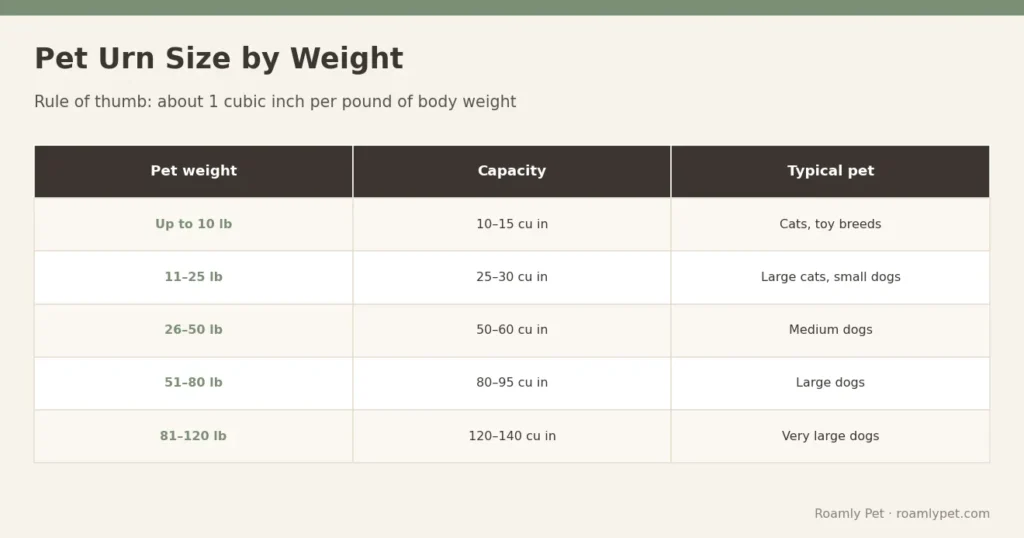
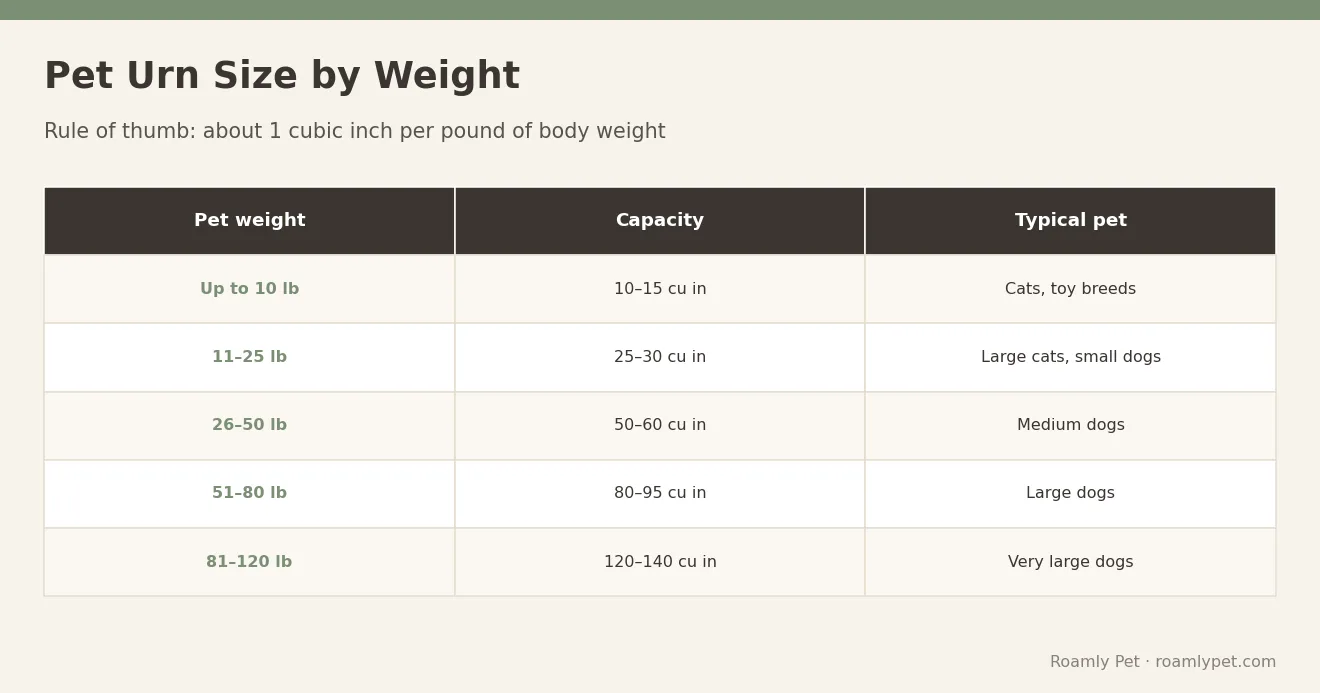
The chart below turns the rule of thumb into ranges you can compare against a product’s listed capacity. Use your pet’s healthy adult weight where possible.
| Pet weight | Suggested capacity | Typical pets |
|---|---|---|
| Up to 10 lb | About 10–15 cubic inches | Most cats, toy breeds |
| 11–25 lb | About 25–30 cubic inches | Large cats, small dogs |
| 26–50 lb | About 50–60 cubic inches | Medium dogs |
| 51–80 lb | About 80–95 cubic inches | Large dogs |
| 81–120 lb | About 120–140 cubic inches | Very large dogs |
| Over 120 lb | Weight in pounds plus a margin | Giant breeds |
If your pet sits near the top of a band, move to the next row. Capacity is usually printed on each product page, so you can compare it directly.
How to Find Your Pet’s Weight
You do not need a precise figure, but a reasonable estimate helps. A few easy ways to find it:
- Vet records: your veterinary clinic will have recent weights on file, and most are happy to share them.
- Home scale: if you weighed your pet at home, use that number. Many people weigh themselves holding the pet and subtract their own weight.
- Crematory paperwork: some providers note the weight on their intake form.
- Breed averages: as a last resort, a typical adult weight for the breed gives a usable estimate.
If your pet lost weight during a long illness, use their healthy adult weight instead. Bone mass changes much less than body weight, so the earlier figure tends to be the better guide for ash volume.
Sizing Considerations for Dogs and Cats
Cats are fairly consistent in size, so most adult cats fit comfortably in a small urn of around 15 to 25 cubic inches. Our cat urns are generally sized with this in mind, though it is still worth checking capacity for a large breed.
Dogs vary far more. A Chihuahua and a Great Dane need very different urns, and mixed breeds can be hard to estimate by looks alone. For dogs, weight matters more than breed, and deep-chested or heavy-boned dogs may return a little more ash than their weight suggests. Browsing dog urns by listed capacity, rather than by the word small or large in a product name, is the most reliable approach.
Think about display space too. A large urn for a big dog will need a sturdy shelf or a dedicated spot, which is worth measuring before you order.
Keepsake and Mini Urns for Sharing Ashes
Many families want to share ashes among relatives, keep a little close by, or scatter some while keeping the rest. Keepsake urns make this possible. They usually hold only a small portion, often a few cubic inches.
Common ways people use them:
- One main urn at home, with keepsakes for children or other family members.
- A small keepsake kept on a desk or bedside table, with the rest scattered somewhere meaningful.
- A set of matching minis so that each person has the same memorial.
If you plan to divide the ashes, you can choose a slightly smaller main urn, since part of the volume will go elsewhere. Our guide to keepsake pet urns covers this in more depth, including how to divide ashes gently.
Companion Urns for Two Pets
Some families plan for two pets to rest together, often littermates or a bonded pair. A companion urn is simply a larger urn, or one with two compartments, designed to hold both.
To size one, add both pets’ weights together and apply the same 1 cubic inch per pound rule. Two 12 lb cats would need roughly 24 to 30 cubic inches; a 60 lb dog and a 10 lb cat would need around 70 to 85.
If the second pet is still with you, it is perfectly fine to choose a companion urn now and fill the second space later. Many people find comfort in knowing the plan is in place. For ideas on styles and engraving two names, see our page on companion urns for two pets.
Common Sizing Mistakes to Avoid
A few small oversights account for most sizing problems:
- Using current weight after illness rather than healthy adult weight.
- Judging by appearance: photos can make urns look larger or smaller than they are, so always check the listed capacity.
- Forgetting the bag: ashes usually come in a sealed bag inside a temporary container, and the bag takes a little room.
- Ignoring the opening: a narrow opening can make transferring the bag awkward, so check how the urn opens.
- Not planning for sharing: decide early whether some ashes will go into keepsakes.
None of these are serious if you catch them early. If you are unsure, sizing up remains the safest choice.
Finding a Fitting Urn
Once you know the capacity you need, you can focus on what matters more: an urn that feels right for your pet. Roamly Pet offers solid wood and hand-glazed ceramic urns, plus biodegradable salt urns for burial or water. Most styles can be personalized with free name-and-date engraving, optional photo laser-engraving or a cast paw print, depending on the product, and each is made or engraved to order and shipped within 3 to 5 business days.
You can start with our dog urns or cat urns, and compare listed capacities against the chart above. If you are between sizes, or have a question about engraving, please contact us. We are glad to help you check the fit before you order.
Frequently Asked Questions
How do I calculate the right urn size for my pet?
Weigh your pet or check vet records for a healthy adult weight, then allow about 1 cubic inch of urn capacity per pound. Compare that figure with the capacity listed on the product page. If your result falls close to the limit, choose the next size up to leave some comfortable room.
What happens if I choose an urn that is too small?
The ashes may not fit, and you might need to store the remainder in a keepsake or temporary container. That is not a disaster, and many families do it on purpose. Still, if you want everything in one place, size up when in doubt and check capacity carefully before ordering.
Do cats need a different urn size than dogs?
The same rule applies to both, but most adult cats weigh between 8 and 15 lb, so a small urn usually fits. Dogs range from a few pounds to well over a hundred, which makes checking weight and capacity far more important. Large cat breeds may simply need the next size up.
Can I put two pets in one urn?
Yes. Companion urns are designed for this, either as one larger space or two separate compartments. Add both pets’ weights together and apply the usual rule of about 1 cubic inch per pound. You can also buy the urn now and add a second pet’s ashes in the future.
Is it fine to keep some ashes and scatter the rest?
Absolutely. Many families divide ashes between a main urn, keepsakes and a meaningful scattering place. If you plan to scatter, check local rules first, as they vary by area. A slightly smaller main urn plus one or two keepsakes is a common and practical arrangement for this.