

Quick answer
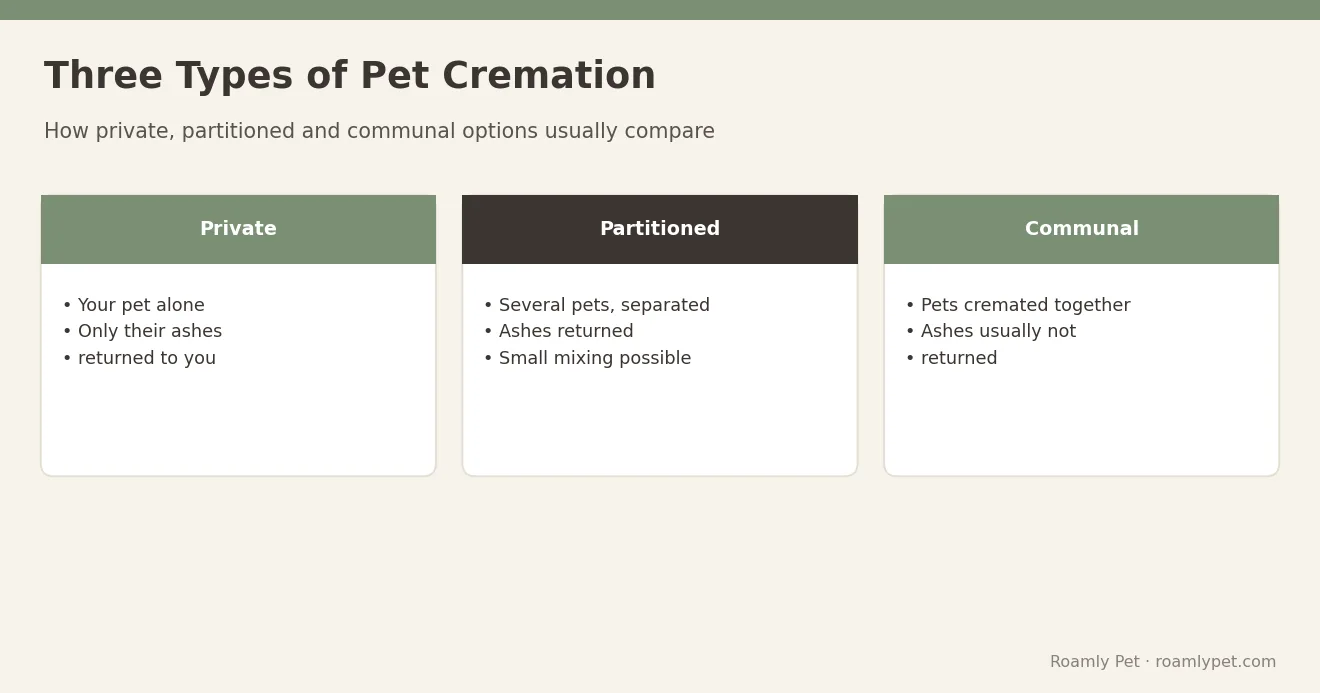
In private cremation your pet is cremated alone and you receive only their ashes. In partitioned (sometimes called individual) cremation, several pets share the chamber but are kept apart, so ashes are returned but small mixing is possible. In communal cremation pets are cremated together and ashes are usually not returned. Terms vary, so always ask your provider to define them.
Choosing between private vs communal pet cremation is often one of the first decisions you face after a pet dies, and it can arrive when you feel least ready to weigh options. The words providers use are not always consistent, which makes the choice harder than it needs to be.
This guide explains the three common types of pet cremation in plain language: private, partitioned and communal. You will learn what each usually involves, whether ashes come home to you, and which questions help you understand exactly what a provider offers. There is no wrong choice here, only the one that fits your family, your plans and your pet.
Private vs Communal Pet Cremation: The Short Version
The main difference comes down to two things: whether your pet is alone in the cremation chamber, and whether you receive ashes afterwards. The table below summarizes how the terms are commonly used, but definitions differ between providers and countries, so treat it as a starting point rather than a rule.
| Type | Pets in chamber | Ashes returned? | Best suited to |
|---|---|---|---|
| Private | Your pet only | Yes, only your pet’s | Keeping ashes in an urn or keepsake |
| Partitioned | Several, separated | Yes, mostly your pet’s | Families wanting ashes back with fewer requirements |
| Communal | Several, together | Usually not | Families who do not plan to keep ashes |
If keeping your pet’s ashes in an urn matters to you, private or partitioned cremation is usually the route to discuss with your vet or crematorium.
What Private Cremation Means
In a private cremation, your pet is placed in the chamber on their own. Once the process is complete, the remains are processed into fine ashes and returned to you, often in a simple temporary container or a basic urn chosen from the provider’s range.
Families often choose private cremation because:
- they want certainty that the ashes belong only to their pet
- they plan to keep the ashes at home in an urn
- they would like to divide ashes among family members using keepsake urns
- they hope to scatter or bury the ashes somewhere meaningful later
Some providers also offer a witnessed or attended cremation, where you can be present at the start of the process. Availability varies, so ask if this is something you would value.
What Partitioned or Individual Cremation Means
Partitioned cremation sits between private and communal. Several pets are cremated at the same time, but each is placed in a separate section of the chamber, kept apart by trays, bricks or dividers. Ashes are then collected from each section and returned to each family.
Because pets share the chamber, a small amount of mixing can occur. Many families are comfortable with this; others prefer the certainty of a fully private cremation. The confusion is that some providers call this option individual cremation, while others use individual to mean private. That is why it helps to ask directly: “Will my pet be the only animal in the chamber?”
What Communal Cremation Means
Communal cremation, sometimes called group or mass cremation, involves several pets being cremated together. Because the remains cannot be separated afterwards, ashes are usually not returned to individual families. Many crematoriums scatter or inter communal ashes respectfully in a garden of remembrance or another designated place, but practices differ, so ask what happens locally.
Communal cremation can be a gentle, practical choice when you do not plan to keep ashes, or when you would rather remember your pet through a photo, a paw print or a favorite collar. It is not a lesser choice; it is simply a different one.
Questions to Ask Your Vet or Crematorium
Most families arrange cremation through their vet, though you can usually contact a pet crematorium directly. Either way, these questions help you understand what you are agreeing to:
- How do you define private, individual and communal cremation?
- Will my pet be alone in the chamber?
- How do you track pets through the process, for example with an ID tag?
- Will I receive the ashes, and in what container?
- How long will it take before the ashes are ready?
- Can I collect them, or will they be returned to the vet?
- Is a witnessed or attended option available?
A reputable provider should be happy to answer calmly and clearly. If timing is on your mind, our guide on how long pet cremation takes walks through each step.
How Cost and Timing Usually Compare
Costs vary by provider, region, your pet’s size and the services you choose, so it is not possible to give reliable figures here. As a general pattern, communal cremation tends to be the least expensive option and private cremation the most, with partitioned somewhere between. Extras such as home collection, out-of-hours care, attended cremation or a decorative urn from the provider may add to the total.
Timing also differs. Communal cremations are often scheduled in batches, while private cremations may be arranged more flexibly. For a clearer picture of what shapes the price, read our guide to pet cremation cost factors and ask for an itemised quote before you decide.
Choosing What Feels Right for Your Family
There is no right answer that suits everyone. It may help to think about what you hope to do in the months ahead:
- Keep ashes at home: private cremation gives the most certainty.
- Bury or scatter later: private or partitioned both work well.
- Share ashes between relatives: private cremation and a set of keepsakes may suit you.
- Remember without ashes: communal cremation with a photo or paw print memorial can feel just as meaningful.
If you are unsure how much ash to expect from a private cremation, our article on how much ash your pet will have explains the common guideline of roughly 1 cubic inch of urn capacity per pound of body weight. It is fine to take a little time; most providers can care for your pet while you decide.
How Roamly Pet Can Help
If you choose private or partitioned cremation, the ashes are often returned in a plain container, and there is no rush to move them. When you are ready, Roamly Pet offers solid wood and hand-glazed ceramic urns, as well as biodegradable salt urns for burial or water. Most styles can be personalized with free name-and-date engraving, an optional photo laser-engraving or a cast paw print, and each urn is made or engraved to order and shipped within 3–5 business days.
You can browse our dog urns or cat urns, and if you have a question about sizing or engraving, our team is glad to help through the contact page.
Frequently Asked Questions
Is private cremation the same as individual cremation?
Not always. Some providers use individual to mean private, with your pet alone in the chamber. Others use it to describe partitioned cremation, where several pets are cremated at once but kept apart. Because the terms overlap, ask your provider whether your pet will be the only animal in the chamber during the process.
Do I get my pet’s ashes back after communal cremation?
Usually not. In communal cremation several pets are cremated together, so the remains cannot be separated afterwards. Many crematoriums scatter or inter communal ashes respectfully in a designated area. If receiving ashes matters to you, discuss private or partitioned cremation with your vet or provider before arrangements are confirmed.
How can I be sure the ashes I receive are my pet’s?
Ask how the provider tracks each pet, for example with a metal ID tag or paperwork that stays with your pet throughout the process. Some offer certificates or a witnessed cremation. A trustworthy provider will explain their procedures openly, and you are entitled to ask questions until you feel comfortable.
Can I change my mind after choosing communal cremation?
Sometimes, if the cremation has not yet taken place. Contact your vet or the crematorium as soon as possible and explain that you would like a different option. Policies and timelines vary, so a quick call is the best way to find out what is still possible for your pet.
Which type of cremation is best if I want an urn?
Private cremation offers the most certainty that the ashes are only your pet’s, which many families prefer for an urn kept at home. Partitioned cremation also returns ashes and may suit you if a small chance of mixing does not concern you. Both work with wooden, ceramic and biodegradable urns.