

Quick answer
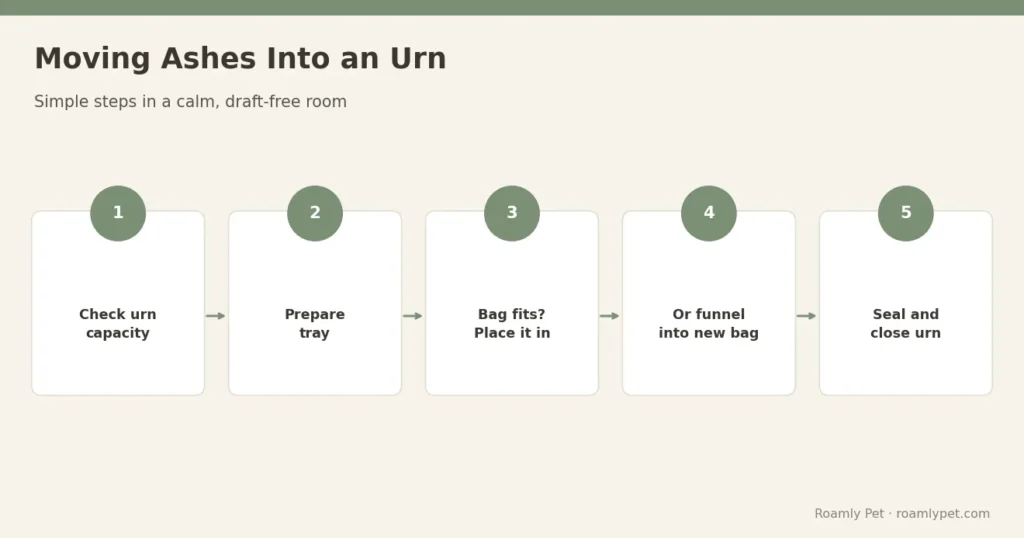
To transfer pet ashes into an urn, check the ashes are in a sealed bag inside the provider’s container. If the bag fits, you can place it straight into the urn. If not, work over a tray in a calm, draft-free room, using a funnel or spoon to move the ashes into a fresh bag inside the urn, then close it securely.
Learning how to transfer pet ashes into an urn is a quiet, practical task, yet it can also feel deeply emotional. For many people it is the first time they have seen their pet’s ashes up close, and that moment deserves care and time.
This guide explains what you will usually find inside the container from the crematorium, what to prepare, and how to move the ashes gently and cleanly, step by step. It also covers sealing the urn and sharing ashes among family keepsakes. There is no right day to do this. Wait until it feels manageable, and ask someone you trust to be with you if that helps.
What You Will Usually Receive From the Crematorium
Most providers return a pet’s ashes in a sealed plastic bag placed inside a temporary container, such as a cardboard box, plastic tub, scatter tube or simple urn. A label or certificate with your pet’s name or reference number is often attached.
Pet ashes are usually pale grey or off-white and slightly coarse, rather than a fine powder like fireplace ash. Small, firmer fragments are normal. Knowing this in advance can make opening the container less of a surprise. The amount depends mostly on your pet’s size; our guide on how much ash your pet will have explains what to expect.
Seeing the ashes for the first time can bring up strong feelings, even if you thought you were prepared. Some people feel comfort, others a fresh wave of sadness, and many feel both. You may want to open the container first, look for a moment, and then return to the transfer another day. That is completely fine; the ashes are safe in their sealed bag for as long as you need.
Before You Start: Check the Urn Size
Before opening anything, make sure your new urn has enough space. A common guideline is about 1 cubic inch of urn capacity per pound of your pet’s healthy body weight, though this is only an estimate. Check the urn’s listed capacity and compare it with the volume of the bag.
If the urn may be a little small, you could keep the remainder in a keepsake urn or scatter a small portion somewhere meaningful. Our pet urn size guide walks through sizing by weight in more detail.
What You Will Need
Gather everything before you begin, so you do not need to step away midway:
- your pet’s ashes in their original container
- the new urn, opened and checked to make sure it is clean and dry
- a large tray, baking sheet or sheet of paper to work over
- a small funnel made of plastic, paper or metal
- a clean spoon or small scoop
- a new resealable bag, if the original bag will not fit the urn
- scissors and a twist tie or tape
- disposable gloves and a soft brush, if you like
Choose a calm, indoor space away from open windows, fans and air vents, as ashes can drift in moving air.
How to Transfer Pet Ashes Into an Urn, Step by Step
- Open the urn. Depending on the design, it may open from the top, have a removable base panel, or a screw-on lid. Set any screws or fittings in a small dish.
- Try the bag first. If the sealed bag fits inside the urn, simply place it in. This is the cleanest option and keeps your pet’s ashes together.
- If it does not fit, place a new bag inside the urn’s opening and fold its edges over the rim.
- Open the original bag carefully over your tray, snipping a small corner if helpful.
- Pour or spoon slowly through the funnel into the new bag, pausing as needed.
- Gather any ashes on the tray gently with a soft brush or paper and add them to the bag.
- Seal the bag with its closure, a twist tie or tape, and tuck it into the urn.
- Close the urn securely, replacing any screws or base panel.
Take breaks whenever you need them. Some people say a few words or share a memory while they work.
Sealing the Urn: Temporary or Permanent
Whether you seal the urn permanently is a personal choice. The table below compares common approaches.
| Approach | How it works | Best for |
|---|---|---|
| Closed, not sealed | Lid or base closed as designed | Keeping options open for later |
| Tape around the seam | Discreet tape on the lid edge or base | Extra security when moving |
| Adhesive or sealant | Small amount on the lid or base seam | Permanent display at home |
| Bag sealed inside | The inner bag keeps ashes contained | Most urns, with any approach |
If you might later want to bury, scatter or share some of the ashes, you may prefer not to seal the urn permanently. If you do use an adhesive, choose one suitable for the urn’s material and test a small, hidden area first.
Sharing Ashes Between Keepsake Urns
Some families divide ashes so that several people can keep a small part, or so that some can be scattered while the rest stays at home. Working over your tray, use a small spoon and funnel to fill each keepsake, sealing each before moving to the next.
Keepsake urns are small, so a little goes a long way. Our guide to keepsake and mini pet urns explains how families share ashes thoughtfully, including how to talk about it together.
If You Would Rather Not Do It Yourself
It is completely fine to ask for help. Some crematoriums or vets will transfer ashes into an urn for you if you bring it in, and a calm friend or family member may be glad to help. You can also simply leave the sealed bag in the provider’s container and place that inside a larger urn or keepsake box, if it fits.
Whatever you choose, there is no wrong way to care for your pet’s ashes. What matters is that it feels respectful to you.
Finding a Fitting Urn
Roamly Pet offers solid wood and hand-glazed ceramic urns for dogs and cats, and biodegradable salt urns for burial or water. If you are deciding between materials, our comparison of wooden vs ceramic pet urns may help. Most styles can be personalized with free name-and-date engraving, an optional photo laser-engraving or a cast paw print, and each urn is made or engraved to order and shipped within 3–5 business days. Browse the full urn collection, and if you have a question about capacity or engraving, please ask us through our contact page.
Frequently Asked Questions
Do I need to take the ashes out of the bag?
Usually not. Many urns are designed so the sealed bag from the crematorium can be placed straight inside, which is the cleanest and simplest option. You only need to transfer the ashes into a new bag if the original one does not fit through the urn’s opening or the urn’s capacity is tight.
Is it safe to handle pet ashes?
Pet ashes are generally considered safe to handle, as they are mainly processed bone fragments. Many people still prefer disposable gloves and work slowly to avoid dust. Wash your hands afterwards, keep the area clear of food, and choose a still, indoor space so the ashes do not drift.
What if the ashes do not all fit in the urn?
If the urn is slightly too small, you can place the remainder in a keepsake urn, scatter a small portion somewhere meaningful, or choose a larger urn. A common guideline is about 1 cubic inch of capacity per pound of body weight, so checking the capacity beforehand helps avoid this.
Can I open the urn again later?
If you have not sealed it permanently, most urns can be reopened, for example by unscrewing a base panel or lifting the lid. This leaves room to share, scatter or bury some ashes in future. If you think you might want to, avoid permanent adhesives and use tape or the urn’s own closure instead.
Should I keep the certificate from the crematorium?
Yes, it is a good idea. The certificate or label confirms your pet’s identity and can be useful if you later travel with the ashes, bury them or move house. Many families keep it in a folder with photos, or tuck a copy inside or beneath the urn.